The Rambam now discusses why he can not go further into the subjects that he has been discussing. He says,
צוו חכמים הראשונים שלא לדרוש בדברים אלו אלא לאיש אחד בלבד והוא שיהיה חכם ומבין מדעתו ואחר כך מוסרין לו ראשי הפרקים ומודיעין אותו שמץ מן הדבר והוא מבין מדעתו וידע סוף הדבר ועומקו. ודברים אלו דברים עמוקים הם עד למאד ואין כל דעת ודעת ראויה לסובלן. ועליהם אמר שלמה בחכמתו דרך משל כבשים ללבושך כך אמרו חכמים בפירוש משל זה דברים שהן כבשונו של עולם יהיו ללבושך כלומר לך לבדך ואל תדרוש אותם ברבים. ועליהם אמר יהיו לך לבדך ואין לזרים אתך. ועליהם אמר דבש וחלב תחת לשונך, כך פירשו חכמים הראשונים דברים שהן כדבש וחלב יהיו תחת לשונך:
"The earlier wise men commanded that these things [that we have discussed in the first two chapters] should not be expounded upon in front of more than one man. Even this should not be done unless this man is wise and has an acute mind to understand things. After this condition is ascertained then this subject should be transmitted to this man, first by just skimming the surface of these subjects and then by only revealing some of the subject. He should then be able to understand these ideas through his wisdom and then be able to figure out the rest of the subject and its deeper meaning through his own intellect.
The ideas that this subject deals with are very deep and not every one's knowledge is able to bear this information. Concerning these deep ideas King Solomon, in his wisdom, gave a parable, 'Let the sheep be your clothes.' The wise ones explained this parable that those things which are secret (the hebrew word word sheep can be read differently and means secret as explained in Chagiga 13A) should be like your clothes, meaning that the esoteric understanding that you attain should be kept for yourself and you should not expound upon them for the multitude. King Solomon also says regarding these matters, 'This shall be for you alone and not for a stranger [to share with you].' King Solomon states further regarding these matters, 'Like honey and milk it lies under your tongue.' The earlier wise men expounded this pasuk to be telling us that these esoteric things are like honey and milk that should be kept under your tongue."
The idea of Maaseh Merkava throughout Kabbalah is that which is mystical. However, the Rambam does not believe in mysticism so it must be understood what exactly he thought the Maaseh Merkava was teaching. In The Guide for the Perplexed the Rambam points out that he thinks the Maaseh Merkava is the subject of metaphysics that can be attained through philosophy as is pointed out in the following passage (Section 1 CHapter 34):
"Now, consider how, in the writings of the Rabbis, the admission of a person into discourses on metaphysics (Maaseh Merkava) is made dependent on distinction in social qualities, and study of philosophy, as well as in the possession of clearsightedness, intelligence, eloquence, and ability to communicate things by slight allusions. If a person satisfies these requirements, the secrets of the Law are confided to him. In the same place we also read the following passage :-R. Jochanan said to R. Elasar, 'Come, I will teach you Maaseh Merkava.' The reply was, 'I am not yet old,' or in other words, I have not yet become old, I still perceive in myself the hot blood and the rashness of youth. You learn from this that, in addition to the above-named good qualities, a certain age is also required."
The Rambam points out that this is why the subject of Maaseh Merkava is only to be taught on an exclusive level. Philosophy is something that is dangerous for the general population to become involved in. In the past, we have seen many people stray away because they have become infatuated with philosophy or science in general. This is why only an extremely wise person that will be able to figure out the truth on his own is taught metaphysics. He will be able to enhance his love of G-D and his understanding of G-D as opposed to someone who will use this knowledge to turn away from G-D.
The Rambam also points out that there are three locations where King Solomon points out that these subjects must remain hidden. There are certain ideas that the general population should not contemplate because they will not understand it and then because of their failed understanding they will turn away from G-D. We can see this to be true based on history. when someone understands some information incorrectly that leads a person in the wrong direction. It is very important to first attain a level that will allow you to understand the more complicated information before diving head first into the complicated information. It is similar to math. A person can not hope to understand complicated math theories without first attaining a knowledge of algebra and calculus. To do so would be irresponsible and foolish. This person is no more equipped to be a mathematician than I am to be an astronaut.
I think an underlying theme that exists here is that a person should not learn any subject that will test the faith of that person if they are not ready for it. Meaning, a person should not learn evolution if they believe that evolution is incompatible with the Torah. The reason for this is that if somehow the person is convinced that evolution is correct they will abandon their religion. However, if they believe that evolution could be compatible with Torah then what is the harm in learning the theory, it will not effect the persons religion in the slightest bit.
Monday, March 30, 2009


Rambam-Maaseh Merkava (Subject Title for discussing G-D's Existence)- Yisodei Hatorah perek 2 halacha 11
The Rambam wants to define the subject matter that he has been discussing for the first two chapters of Yisodei Hatorah. He says,
דברים אלו שאמרנו בענין זה בשני פרקים אלו כמו טיפה מן הים הם ממה שצריך לבאר בענין זה. וביאור כל העיקרים שבשני פרקים אלו הוא הנקרא מעשה מרכבה:
"These things that we have said regarding the matters in these first two chapters is like a drop in the ocean of what must be explained about these matters. The explanation of all of these fundamental ideas in these first two chapters is referred to as Maaseh Merkava."
Now that the Rambam has brought up the phrase "Maaseh Merkava" it is important to understand what that means. According to Rambam the "maaseh Merkava" refers to Metaphysics. Basically, the understanding of G-D. The words refer to the vision of Ezekial that he saw a chariot (Merkava) that G-D was on being led by four Chayos, the highest level of angels.
The Rambam is simply pointing out that he is not giving a detailed description of the "Maaseh Merkava," rather he is just teaching the foundations that one needs in order to understand it on a basic level. This is is why the Rambam devotes a small section to these ideas in the Mishna Torah. However, in his famous work The Guide for the Perplexed, the Rambam discusses the "Maaseh Merkava" in great detail.
דברים אלו שאמרנו בענין זה בשני פרקים אלו כמו טיפה מן הים הם ממה שצריך לבאר בענין זה. וביאור כל העיקרים שבשני פרקים אלו הוא הנקרא מעשה מרכבה:
"These things that we have said regarding the matters in these first two chapters is like a drop in the ocean of what must be explained about these matters. The explanation of all of these fundamental ideas in these first two chapters is referred to as Maaseh Merkava."
Now that the Rambam has brought up the phrase "Maaseh Merkava" it is important to understand what that means. According to Rambam the "maaseh Merkava" refers to Metaphysics. Basically, the understanding of G-D. The words refer to the vision of Ezekial that he saw a chariot (Merkava) that G-D was on being led by four Chayos, the highest level of angels.
The Rambam is simply pointing out that he is not giving a detailed description of the "Maaseh Merkava," rather he is just teaching the foundations that one needs in order to understand it on a basic level. This is is why the Rambam devotes a small section to these ideas in the Mishna Torah. However, in his famous work The Guide for the Perplexed, the Rambam discusses the "Maaseh Merkava" in great detail.
Sunday, March 29, 2009
Rambam- How G-D's Knowledge and Existence Can Relate to Man- Yisodei Hatorah Perek 2 Halacha 10
How does G-D think? How does G-D exist? These are some of the questions that are dealt with in the Rambam. He says,
הקב"ה מכיר אמתו ויודע אותה כמו שהיא. ואינו יודע בדעה שהיא חוץ ממנו כמו שאנו יודעין. שאין אנו ודעתנו אחד אבל הבורא יתברך הוא ודעתו וחייו אחד מכל צד ומכל פינה ובכל דרך ייחוד. שאלמלי היה חי בחיים ויודע בדעה חוץ ממנו היו שם אלוהות הרבה הוא וחייו ודעתו, ואין הדבר כן אלא אחד מכל צד ומכל פינה ובכל דרך ייחוד. נמצאת אתה אומר הוא היודע והוא הידוע והוא הדעה עצמה הכל אחד. ודבר זה אין כח בפה לאומרו ולא באוזן לשמעו ולא בלב האדם להכירו על בוריו. ולפיכך אומר חֵי פרעה וחֵי נפשך ואין אומר חֵי ה' אלא חַי ה'. שאין הבורא וחייו שנים כמו חיי הגופים החיים או כחיי המלאכים. לפיכך אינו מכיר הברואים ויודעם מחמת הברואים כמו שאנו יודעין אותם אלא מחמת עצמו ידעם. לפיכך מפני שהוא יודע עצמו יודע הכל שהכל נסמך לו בהוייתו:
"G-D recognizes His truth and He knows it in the way it truly exists. He does not know His truth through an outside knowledge like we know, because we and our minds are separate, rather the Creator, He, His knowledge and His life are all one from every angle. If G-D would live a life [like us], or know things through having a knowledge [like us] then there would be many gods being Him, His life and His knowledge. This is not so, rather G-D is singular from every side, angle and in every aspect.
It is said about G-D that He knows, is known and knows Himself all at once. However, this idea can not be related through the force (words) of the mouth, it can not be heard (related) to the ears, nor is it within a man's heart to recognize [the truth] of his Creator. Therefore, we say 'by the life of Pharoh' and 'by the life of your soul,' but by G-D we do not say 'by the life of G-D,' rather we say 'As G-D lives.' [This is because] the Creator and His life are not separate things like the life of a physical body or the life of an angel. Therefore, [G-D] does not recognize and know the creations because of how they are like we understand them, rather He [recognizes and knows them] because He knows Himself. Therefore, because He knows Himself He knows everything, because everything relies on His existence."
It is interesting to point out that the Ralbag, in his book The Wars of the Lord, argues on the Rambam's understanding here. The Ralbag, Aristotle and the Rambam all disagree on how G-D relates to the world. This all stems from the problem they all face, how does a G-D that is perfect and singular relate to a world that is imperfect and many? Hopefully, I will be able to discuss the Ralbag and Aristotle in a later post, but right now I want to focus on the Rambam.
The Rambam's underlying theme here is that G-D can not understand man (or the rest of the physical world for that matter) in the same manner that man understands man. He points out that if G-D did understand man in the same manner that man understands man, then it would have to be that G-D is not a singular being that is unchanging, but rather pluralistic and changes like man. As stated in the third section of the Rambam's The Guide for The Perplexed (Section 3 Chapter 16), "knowledge of individual beings, that are subject to change, necessitates some change in him who possesses it, because this knowledge itself changes constantly." Therefore, it is incumbent upon the Rambam to explain how it is that G-D can have knowledge and a relation to man while still maintaining His singularity and unchanging stature.
Ingeniously, as the Rambam always is, he comes up with a solution. He explains that G-D's knowledge and existence is completely different than our knowledge and existence. G-D is a being that has a knowledge, a life and an existence that is all one and unchanging. Once this idea is apparent then we can explain how this singular being can relate to a multitude. G-D's knowledge of Himself, His own existence and His life allows Him to relate and know of all other existences. How? Because His existence causes all other existences. All other existences are contingent upon His existence and His relation to them. Therefore, G-D's knowledge and understanding of all things is not as we perceive it, rather it is channeled through G-D and therefore does not directly relate to the pluralistic existences that change. This is how the Rambam solves His problem of 'How can a singular being relate to the pluralistic world that continuously changes,' He understands Himself, the unchanging being, and through that knowledge understands the pluralistic and changing existences.
הקב"ה מכיר אמתו ויודע אותה כמו שהיא. ואינו יודע בדעה שהיא חוץ ממנו כמו שאנו יודעין. שאין אנו ודעתנו אחד אבל הבורא יתברך הוא ודעתו וחייו אחד מכל צד ומכל פינה ובכל דרך ייחוד. שאלמלי היה חי בחיים ויודע בדעה חוץ ממנו היו שם אלוהות הרבה הוא וחייו ודעתו, ואין הדבר כן אלא אחד מכל צד ומכל פינה ובכל דרך ייחוד. נמצאת אתה אומר הוא היודע והוא הידוע והוא הדעה עצמה הכל אחד. ודבר זה אין כח בפה לאומרו ולא באוזן לשמעו ולא בלב האדם להכירו על בוריו. ולפיכך אומר חֵי פרעה וחֵי נפשך ואין אומר חֵי ה' אלא חַי ה'. שאין הבורא וחייו שנים כמו חיי הגופים החיים או כחיי המלאכים. לפיכך אינו מכיר הברואים ויודעם מחמת הברואים כמו שאנו יודעין אותם אלא מחמת עצמו ידעם. לפיכך מפני שהוא יודע עצמו יודע הכל שהכל נסמך לו בהוייתו:
"G-D recognizes His truth and He knows it in the way it truly exists. He does not know His truth through an outside knowledge like we know, because we and our minds are separate, rather the Creator, He, His knowledge and His life are all one from every angle. If G-D would live a life [like us], or know things through having a knowledge [like us] then there would be many gods being Him, His life and His knowledge. This is not so, rather G-D is singular from every side, angle and in every aspect.
It is said about G-D that He knows, is known and knows Himself all at once. However, this idea can not be related through the force (words) of the mouth, it can not be heard (related) to the ears, nor is it within a man's heart to recognize [the truth] of his Creator. Therefore, we say 'by the life of Pharoh' and 'by the life of your soul,' but by G-D we do not say 'by the life of G-D,' rather we say 'As G-D lives.' [This is because] the Creator and His life are not separate things like the life of a physical body or the life of an angel. Therefore, [G-D] does not recognize and know the creations because of how they are like we understand them, rather He [recognizes and knows them] because He knows Himself. Therefore, because He knows Himself He knows everything, because everything relies on His existence."
It is interesting to point out that the Ralbag, in his book The Wars of the Lord, argues on the Rambam's understanding here. The Ralbag, Aristotle and the Rambam all disagree on how G-D relates to the world. This all stems from the problem they all face, how does a G-D that is perfect and singular relate to a world that is imperfect and many? Hopefully, I will be able to discuss the Ralbag and Aristotle in a later post, but right now I want to focus on the Rambam.
The Rambam's underlying theme here is that G-D can not understand man (or the rest of the physical world for that matter) in the same manner that man understands man. He points out that if G-D did understand man in the same manner that man understands man, then it would have to be that G-D is not a singular being that is unchanging, but rather pluralistic and changes like man. As stated in the third section of the Rambam's The Guide for The Perplexed (Section 3 Chapter 16), "knowledge of individual beings, that are subject to change, necessitates some change in him who possesses it, because this knowledge itself changes constantly." Therefore, it is incumbent upon the Rambam to explain how it is that G-D can have knowledge and a relation to man while still maintaining His singularity and unchanging stature.
Ingeniously, as the Rambam always is, he comes up with a solution. He explains that G-D's knowledge and existence is completely different than our knowledge and existence. G-D is a being that has a knowledge, a life and an existence that is all one and unchanging. Once this idea is apparent then we can explain how this singular being can relate to a multitude. G-D's knowledge of Himself, His own existence and His life allows Him to relate and know of all other existences. How? Because His existence causes all other existences. All other existences are contingent upon His existence and His relation to them. Therefore, G-D's knowledge and understanding of all things is not as we perceive it, rather it is channeled through G-D and therefore does not directly relate to the pluralistic existences that change. This is how the Rambam solves His problem of 'How can a singular being relate to the pluralistic world that continuously changes,' He understands Himself, the unchanging being, and through that knowledge understands the pluralistic and changing existences.
Wednesday, March 25, 2009
Rambam- What G-D's Perception of Himself Means- Yisodei Hatorah perek 2 halacha 9
The Rambam discusses what the basic requirements are for the world to exist. Also, he points out what aspects of G-D relate to the world and perpetuate its existence. He says,
כל הנמצאים חוץ מן הבורא מצורה הראשונה עד יתוש קטן שיהיה בטבור הארץ הכל מכח אמתתו נמצאו. ולפי שהוא יודע עצמו ומכיר גדולתו ותפארתו ואמתתו הוא יודע הכל ואין דבר נעלם ממנו:
"All of the beings, except for the creator, from the first tzura (spiritual being/purpose) to the tiny bug that is in the navel of the earth, all exist from the force of G-D's truth. Also, because He knows Himself and recognizes His greatness, His glory and His truth, He knows everything and nothing is hidden from Him."
The Rambam uses very specific language here. He points out that the greatest of all creations is the first tzura (spiritual existence/purpose) that exists closest to G-D. This is the Chayos, the angel that exists on the highest level of holiness. I believe this because as the Rambam previously stated, the Chayos are the creation that best understand G-D. The greater a beings knowledge of G-D, then the greater an existence they are considered to have. A bug, on the other hand, that is at the center of the earth, is considered to be the most physical of all beings. It has the lowest level of understanding of G-D and is, therefore, considered to be the most distant of all beings from G-D. Nevertheless, even though these beings are worlds apart, they both exist from the truth of G-D. It is impossible to understand this truth since it is His essence and, according to the Rambam, it is impossible to know the essence of G-D.
It is interesting that the Rambam uses the language that since G-D realizes His own greatness, glory and truth He therefore knows everything. What do G-D's attributes have to do with knowing everything?
I believe the Rambam is telling us that the ultimate knowledge is an understanding of G-D. Therefore, since G-D is the only one that knows Himself, He is the one that knows everything. All information in the world is just a pathway to understanding and knowing G-D. Therefore, the more knowledge of anything that one acquires, the more knowledge of G-D one posseses. The Rambam even says in his book The Guide for The Perplexed (section 3 Chapter 18), "For the action of Divine Providence is proportional to the endowment of intellect." He is telling us that the more knowledge we acquire, the closer we come to G-D.
כל הנמצאים חוץ מן הבורא מצורה הראשונה עד יתוש קטן שיהיה בטבור הארץ הכל מכח אמתתו נמצאו. ולפי שהוא יודע עצמו ומכיר גדולתו ותפארתו ואמתתו הוא יודע הכל ואין דבר נעלם ממנו:
"All of the beings, except for the creator, from the first tzura (spiritual being/purpose) to the tiny bug that is in the navel of the earth, all exist from the force of G-D's truth. Also, because He knows Himself and recognizes His greatness, His glory and His truth, He knows everything and nothing is hidden from Him."
The Rambam uses very specific language here. He points out that the greatest of all creations is the first tzura (spiritual existence/purpose) that exists closest to G-D. This is the Chayos, the angel that exists on the highest level of holiness. I believe this because as the Rambam previously stated, the Chayos are the creation that best understand G-D. The greater a beings knowledge of G-D, then the greater an existence they are considered to have. A bug, on the other hand, that is at the center of the earth, is considered to be the most physical of all beings. It has the lowest level of understanding of G-D and is, therefore, considered to be the most distant of all beings from G-D. Nevertheless, even though these beings are worlds apart, they both exist from the truth of G-D. It is impossible to understand this truth since it is His essence and, according to the Rambam, it is impossible to know the essence of G-D.
It is interesting that the Rambam uses the language that since G-D realizes His own greatness, glory and truth He therefore knows everything. What do G-D's attributes have to do with knowing everything?
I believe the Rambam is telling us that the ultimate knowledge is an understanding of G-D. Therefore, since G-D is the only one that knows Himself, He is the one that knows everything. All information in the world is just a pathway to understanding and knowing G-D. Therefore, the more knowledge of anything that one acquires, the more knowledge of G-D one posseses. The Rambam even says in his book The Guide for The Perplexed (section 3 Chapter 18), "For the action of Divine Providence is proportional to the endowment of intellect." He is telling us that the more knowledge we acquire, the closer we come to G-D.
Monday, March 23, 2009
Rambam- Angels understanding of G-D- Yisodei Hatorah perek 2 halacha 8
The Rambam discusses what the abilities of the angels are in regard to their intelligence and capabilities of comprehension of G-D.
וכל הצורות האלו חיים ומכירין את הבורא ויודעים אותו דעה גדולה עד למאד. כל צורה וצורה לפי מעלתה לא לפי גודלה. אפילו מעלה הראשונה אינה יכולה להשיג אמתת הבורא כמו שהוא אלא דעתה קצרה להשיג ולידע אבל משגת ויודעת יותר ממה שמשגת ויודעת צורה שלמטה ממנה. וכן כל מעלה ומעלה עד מעלה עשירית גם היא יודעת הבורא דעה שאין כח בני האדם המחוברים מגולם וצורה יכול להשיג ולידע כמותה. והכל אינן יודעין הבורא כמו שהוא יודע עצמו:
"All of these tzuras (angels) are alive and recognize the creator and know Him with a very great knowledge. [This is true] for every tzura (angel) according to its level [of holiness], but not according to its greatness. However, even the highest level [of the angels] is not able to apprehend the absolute truth of the creator, rather they can only attain a limited amount of knowledge [of G-D]. [Each angel] is able to attain and know more than the tzura (angel) that is below it [in holiness]. Also, every level [of angel] is able to know the creator in a way that is unattainable by man since he is made up of a physical body that is connected to a tzura (spiritual form). Nevertheless, none of these beings are able to know the creator like He knows Himself."
The Rambam is describing the different levels that exist in the knowledge of G-D. G-D is an infinite being and therefore anything that is not infinite can not apprehend His true form. However, the closer to infinity a being is, the more of G-D can be understood. This is what the Rambam is saying, since the angels that are greater in holiness are closer to this infinite being they can more readily understand Him. For example, the number Pi is an infinite number. However, what number is closer to Pi, 3.14 or 3.14159265? Obviously, it is the number with more decimal points, the more precise the number then the closer to Pi, but no matter what, it is impossible to fully map the number Pi. Correlate this to the angels and you will see that the higher an angel is the greater capacity for understanding G-D it has.
The Rambam says that an angel can better understand G-D according to its level [of holiness], but not according to its greatness. What does this mean? According to how I am explaining the Rambam I think it fits very nicely. The Rambam is saying that G-D is infinite and the only way to understand a being that is infinite is to be infinite. However, there are no beings other than G-D that are infinite, therefore, only G-D can truly understand Himself. Nevertheless, the closer a being is to G-D the better that being understands G-D. This means that a being's comprehension of G-D is based on the finiteness of their existence. For example, a human can better understand G-D than an ant because an ant's existence is more finite than a human's. Similarly, every level of angel has a different level of finiteness to their existence which, in turn, limits or increases their ability to apprehend G-D.
This is what the Rambam means by level [of holiness] and not greatness. Greatness represents importance and power of an object. In the scheme of understanding G-D these traits are meaningless for an angel since they have no physicality. However, level of holiness represents the level of finiteness of the angels and this also describes the ability of those angels to understand G-D.
וכל הצורות האלו חיים ומכירין את הבורא ויודעים אותו דעה גדולה עד למאד. כל צורה וצורה לפי מעלתה לא לפי גודלה. אפילו מעלה הראשונה אינה יכולה להשיג אמתת הבורא כמו שהוא אלא דעתה קצרה להשיג ולידע אבל משגת ויודעת יותר ממה שמשגת ויודעת צורה שלמטה ממנה. וכן כל מעלה ומעלה עד מעלה עשירית גם היא יודעת הבורא דעה שאין כח בני האדם המחוברים מגולם וצורה יכול להשיג ולידע כמותה. והכל אינן יודעין הבורא כמו שהוא יודע עצמו:
"All of these tzuras (angels) are alive and recognize the creator and know Him with a very great knowledge. [This is true] for every tzura (angel) according to its level [of holiness], but not according to its greatness. However, even the highest level [of the angels] is not able to apprehend the absolute truth of the creator, rather they can only attain a limited amount of knowledge [of G-D]. [Each angel] is able to attain and know more than the tzura (angel) that is below it [in holiness]. Also, every level [of angel] is able to know the creator in a way that is unattainable by man since he is made up of a physical body that is connected to a tzura (spiritual form). Nevertheless, none of these beings are able to know the creator like He knows Himself."
The Rambam is describing the different levels that exist in the knowledge of G-D. G-D is an infinite being and therefore anything that is not infinite can not apprehend His true form. However, the closer to infinity a being is, the more of G-D can be understood. This is what the Rambam is saying, since the angels that are greater in holiness are closer to this infinite being they can more readily understand Him. For example, the number Pi is an infinite number. However, what number is closer to Pi, 3.14 or 3.14159265? Obviously, it is the number with more decimal points, the more precise the number then the closer to Pi, but no matter what, it is impossible to fully map the number Pi. Correlate this to the angels and you will see that the higher an angel is the greater capacity for understanding G-D it has.
The Rambam says that an angel can better understand G-D according to its level [of holiness], but not according to its greatness. What does this mean? According to how I am explaining the Rambam I think it fits very nicely. The Rambam is saying that G-D is infinite and the only way to understand a being that is infinite is to be infinite. However, there are no beings other than G-D that are infinite, therefore, only G-D can truly understand Himself. Nevertheless, the closer a being is to G-D the better that being understands G-D. This means that a being's comprehension of G-D is based on the finiteness of their existence. For example, a human can better understand G-D than an ant because an ant's existence is more finite than a human's. Similarly, every level of angel has a different level of finiteness to their existence which, in turn, limits or increases their ability to apprehend G-D.
This is what the Rambam means by level [of holiness] and not greatness. Greatness represents importance and power of an object. In the scheme of understanding G-D these traits are meaningless for an angel since they have no physicality. However, level of holiness represents the level of finiteness of the angels and this also describes the ability of those angels to understand G-D.
Saturday, March 21, 2009
The Ancient Synagogue In Capharnaum (Capernaum)
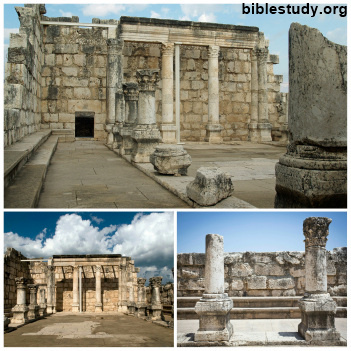
Ancient synagogues have been found all over Israel and the Diaspora with their own unique stories, but most of these structures are completely destroyed. However, there are a few ancient synagogues that have withstood the decimation of time or have been reconstructed in order for archeologists to better understand their significance and meaning. One of these unique synagogues is located in the town of Capharnaum (Capernaum). The archeologists have discovered many details and important facts about this structure. For example, there seems to be an older synagogue that existed centuries earlier on the very spot of the current synagogue. Also, like every great archeological find there is a debate over when the standing synagogue was constructed, either in the second, third or fourth century C.E.
The first thing to look at when trying to describe this synagogue, or any other synagogue, is the city it was built in. Archeologists must first research the history of the surrounding city of Capernaum if they are to understand this synagogue. The history behind this city is quit interesting. Around the beginning of the Common Era, the fishing village of Capernaum was entirely Jewish. Later, a Roman garrison was stationed there with a centurion at its head. However, it seems that it was this Roman centurion that ordered the building of the synagogue.
The first synagogue, that was ordered to be built by the Roman centurion, no longer exists, but as archaeologists have shown in recent digs, its remnants lie buried under the present synagogue. The present synagogue was either built in the second, third or fourth century on top of the ruins of the original synagogue. Richard Horsley suggests that it was early Christians that used the original synagogue and not Jews. His ideas are based on the fact that this synagogue was never mentioned by Galilean rabbis and it is in close proximity to the Byzantine church that Constantine constructed over the reputed "house of Peter." If this synagogue was used by Christians then the foundation beneath it probably did not belong to a functioning Jewish synagogue. Contrary to Horsley, St. Epiphanius informs us that until the fourth century C.E. the population of Capharnaum was entirely Jewish. Although, some passages of the Mishna stress that the Jewish population of Capharnaum during the first three centuries of the Christian era formed two distinct and antagonistic blocks which were Orthodox Jews and Minim (heretics). From the context it is clear that the Minim of Capharnaum were Jews converted to Christianity.
The reason archeologists believe there to have been a building in the first century under the White Synagogue, the name of the currently standing synagogue, is because archeologists have actually cut open the floor and found remains dating back to the first Century. There are several reasons why these remains are thought to be a synagogue. Firstly, the area of the first century stone pavement found under the White Synagogue is too large to be interpreted as belonging to a private house, and is therefore better understood as the remains of a public building. Another reason for this is that it is well known that religious structures were normally rebuilt in the same sacred area through the centuries. In the specific case of Capernaum, the presence of an earlier synagogue would better explain why the fourth (or second or third) century Jewish community of the village chose this very spot to raise the monumental White Synagogue. This holds true even in spite of the fact that the area was extremely close to a Christian shrine.
The synagogue must have stood out among the humble dwellings of the population. It was built almost entirely of white blocks of calcareous stone brought from outside of the city and those white stones lie on a base of basalt stone. The building consists of four parts which were the praying hall, the western patio, a southern balustrade and a small room at the northwest of the building. In the praying hall there was a place for the Torah scrolls and that was on the side that faced toward Jerusalem. In the center of the room there were two bimas where the Torah scrolls were probably read from. The internal walls were covered with painted plaster found during the excavations. The synagogue still has two inscriptions to this day that remember the benefactors that helped in the construction of the building. Also, there is amazing artwork in the synagogue. The architectural ornamentation of the Capernaum building has Corinthian capitals and intricately carved stonework. One relief carving of a cart seems to depict a portable Ark of the Covenant. The most interesting piece of artwork in the synagogue is the swastikas, but most scholars deem them normal decorations for that time.
With all great archeological finds there is always a debate as to what is really found. In the case of Capernaum there are several different theories as to when the synagogue was built. Stanislao Loffred, a Franciscan, has recently found 30,000 Roman coins and pottery shards that date back to the fourth Century beneath the floor of the Synagogue. Yet, Albright previously dated the synagogue to the third Century along with Watzinger who claimed the synagogue to be early third or late second Century. One might answer for these two earlier scholars that the coins found were just left there when repairs were made to the synagogue since there are proponents that give off the impression that the building was erected in the second century or third. One last theory is that the synagogue was rebuilt by Julian the apostate after a major earthquake ravaged the structure. All of these theories have been based on artwork, style and historical events. Furthermore, the use of the different carvings on the walls and the structures of the columns add weight to these earlier archeologist’s claims.
The decorations in this synagogue are numerous. The archeologists found figures of animals, as in a cornice depicting a sea horse and two eagles with a wreath in their beaks. An eagle also appears in the center of the lintel above the main entrance to the prayer hall. On the lintel above the western entrance to the prayer hall appears a lion; statues of lions were apparently also placed on both sides of the roof. These motifs were not very common for a synagogue, but some motifs were found that were very common. For example, a seven-branched menorah with a ram's horn and an incense shovel appears on one capital; on a lintel is a chariot, which is widely regarded as depicting the Ark of the Covenant. Other carvings include palm fronds, clusters of grapes and pomegranates. There are also geometric motifs, including rosettes, stars, pentagons and hexagons. These decorations along with other factors led Watzinger to believe that this synagogue was built between the second and third Centuries since it has many Roman architectural elements from the third century. The researchers conclude this since the synagogue includes Roman architectural elements like the architraves, the friezes, the cornices and the different types of motifs. However, Stanislao Loffred believes the coins and pottery to be the main evidence of the age of the synagogue and dismisses these decorations and says they could have been made in the fourth or fifth century.
Stanislao Loffred, believing that the Roman coins and pottery is the end all be all in dating the synagogue, seems to be mistaken. The architecture of the building and the decorations seem to be much more telling and important when it comes to dating the synagogue. If the carvings on the wall and the columns holding the building up support a second or third century structure, how could one assume that Roman coins from years later were definitely there at the building of the synagogue. Perhaps those coins were dropped there at a later date. Surely, that is more plausible than the decor of the building being out of its place in history.
The synagogue in Capernaum is one of the grandest structures left from ancient times. It seems to have been built in the second or third century. The coins found there should not defeat the structure or the carvings in anyway for dating purposes. The synagogue could have been populated by Jews or by Christians. The town, however, seems to have been inhabited by Jews and Christians and they seemed to have co-existed amicably among one another.
Wednesday, March 18, 2009
Rambam- The Ten Types of Angels- Yisdoei Hatorah perek 2 halacha 7
The Rambam describes all the different types of angels that exist. He says,
שינוי שמות המלאכים על שם מעלתם הוא. ולפיכך נקראים חיות הקדש והם למעלה מן הכל ואופנים ואראלים וחשמלים ושרפים ומלאכים ואלהים ובני אלהים וכרובים ואישים. כל אלו עשרה השמות שנקראו בהן המלאכים על שם עשר מעלות שלהן הן, ומעלה שאין למעלה ממנה אלא מעלת האל ברוך הוא היא מעלת הצורה שנקראת חיות. לפיכך נאמר בנבואה שהן תחת כסא הכבוד. ומעלה עשירית היא מעלת הצורה שנקראת אישים והם המלאכים המדברים עם הנביאים ונראים להם במראה הנבואה. לפיכך נקראו אישים שמעלתם קרובה למעלת דעת בני אדם:
"The different names ascribed to the angels correlates to their [spiritual] height. Therefore, the highest of all angels are the Chayos Hakodesh, then Ophanim, Areilim, Chashmailim, Seraphim, Malachim, Elokim, Bnei Elokim, Kerubim, and, lastly, Ishim. All of these ten names for angels are given because of the ten levels [of holiness] they represent. The highest of all the levels, that the only level above it is G-D, is the level that has the tzura (form and purpose) of Chayos. This is why, in prophecy, they are referred to as being just beneath the throne of glory. The lowest of the ten levels is that which is represented by the tzura (form and purpose) of Ishim. These angels speak with the prophets and they are the ones seen in visions of prophecy. This is why these angels are called Ishim, because they are the closest to [being comprehended by] the knowledge of man."
The different names are very telling of how close they are to G-D. The closer the angels are to G-D, the more knowledge they have of Him.
The first level of angels immediately below G-D are the Chayos. Chayos means supporters, this is similar to the purpose of Chava. Just like woman was created in order to be a helper for man, so too G-D created Chayos to be His supporters. This is why the highest level of angels is called Chayos, because the name Chayos represents the ultimate assistant.
The second class of angels are called Ophanim. The word Ophanim refers to a plan. The plan that is referred to by these angels is the plan that is drawn out in order to prepare for a real action.
The third level of angels are the Areilim. This comes from the word Ariel, meaning divine light. This divine light is the realization of G-D's action in the spiritual world, while it has yet to be materialized in the physical world.
The fourth level of angels are the Chashmeilim. They are called this since Chashmal refers to a glittering substance. These angels are similar to a glittering substance since they reflect the divine light from the Areilim. The reflection of the light diminishes the intensity of the light.
The Fifth level of angels are the Seraphim. These angels absorb the light that is reflected from the Chashmeilim. The word saraph can mean to absorb a substance, here the angels are absorbing the remainder of the divine light in order to transfer it to the next level of angels.
The sixth level of angels are the Malachim. The Malachim refer to teachers that are able to take an idea that is completely abstract and explain it. These angels are able to start the conversion process of a completely spiritual idea and begin its transformation into the physical world.
The seventh level of angels are the Elokim. These angels are similar to the physical rulers of the world. In the bible the word Elokim is sometimes used for kings and rulers. Similar to this, the Elokim are the angels that transfer the idea from the spiritual world and physically put the original idea, that started from G-D, into the physical world.
The Eighth level of angels are the Bnei Elokim. The Elokim take the idea from the Malachim and put the idea into the physical world, but the Bnei Elokim are the angels that guide the idea in the physical world. This is in order that the idea work in the way that it was intended to work.
The ninth level of angels are known as the Kerubim. These angels are similar to children. They represent the pure idea and transformation of G-D's will before any human involvement and complication. This is the final level of angels that are disconnected from man.
The tenth and final level of angels are the Ishim. They are called this because of their connection to man. Ishim are the angels that relate the idea of G-D into the physical world in a way man can understand it. Whether it be a message to a prophet, or a physical manifestation of G-D's will, like rain, the Ishim are what cause these events to occur in the physical world.
This is how I would describe the ten different levels of angels and their purposes. The angels all relate to the existences above or below them in holiness. This starts with an idea from G-D, that is related to the Chayos directly from G-D, and it ends with the Ishim relating the idea to man.
This explanation assumes that the Rambam would agree to the Ramban, that the name of an object reflects the objects inner essence. The Ramban states this opinion in Breishis (35:18). He says that the name of a person tells much about his future because his name reflects his essence. If the Rambam would agree to this, which I have not found him to explicitly agree or disagree, then he would most likely agree to this explanation of the ten levels of angels.
שינוי שמות המלאכים על שם מעלתם הוא. ולפיכך נקראים חיות הקדש והם למעלה מן הכל ואופנים ואראלים וחשמלים ושרפים ומלאכים ואלהים ובני אלהים וכרובים ואישים. כל אלו עשרה השמות שנקראו בהן המלאכים על שם עשר מעלות שלהן הן, ומעלה שאין למעלה ממנה אלא מעלת האל ברוך הוא היא מעלת הצורה שנקראת חיות. לפיכך נאמר בנבואה שהן תחת כסא הכבוד. ומעלה עשירית היא מעלת הצורה שנקראת אישים והם המלאכים המדברים עם הנביאים ונראים להם במראה הנבואה. לפיכך נקראו אישים שמעלתם קרובה למעלת דעת בני אדם:
"The different names ascribed to the angels correlates to their [spiritual] height. Therefore, the highest of all angels are the Chayos Hakodesh, then Ophanim, Areilim, Chashmailim, Seraphim, Malachim, Elokim, Bnei Elokim, Kerubim, and, lastly, Ishim. All of these ten names for angels are given because of the ten levels [of holiness] they represent. The highest of all the levels, that the only level above it is G-D, is the level that has the tzura (form and purpose) of Chayos. This is why, in prophecy, they are referred to as being just beneath the throne of glory. The lowest of the ten levels is that which is represented by the tzura (form and purpose) of Ishim. These angels speak with the prophets and they are the ones seen in visions of prophecy. This is why these angels are called Ishim, because they are the closest to [being comprehended by] the knowledge of man."
The different names are very telling of how close they are to G-D. The closer the angels are to G-D, the more knowledge they have of Him.
The first level of angels immediately below G-D are the Chayos. Chayos means supporters, this is similar to the purpose of Chava. Just like woman was created in order to be a helper for man, so too G-D created Chayos to be His supporters. This is why the highest level of angels is called Chayos, because the name Chayos represents the ultimate assistant.
The second class of angels are called Ophanim. The word Ophanim refers to a plan. The plan that is referred to by these angels is the plan that is drawn out in order to prepare for a real action.
The third level of angels are the Areilim. This comes from the word Ariel, meaning divine light. This divine light is the realization of G-D's action in the spiritual world, while it has yet to be materialized in the physical world.
The fourth level of angels are the Chashmeilim. They are called this since Chashmal refers to a glittering substance. These angels are similar to a glittering substance since they reflect the divine light from the Areilim. The reflection of the light diminishes the intensity of the light.
The Fifth level of angels are the Seraphim. These angels absorb the light that is reflected from the Chashmeilim. The word saraph can mean to absorb a substance, here the angels are absorbing the remainder of the divine light in order to transfer it to the next level of angels.
The sixth level of angels are the Malachim. The Malachim refer to teachers that are able to take an idea that is completely abstract and explain it. These angels are able to start the conversion process of a completely spiritual idea and begin its transformation into the physical world.
The seventh level of angels are the Elokim. These angels are similar to the physical rulers of the world. In the bible the word Elokim is sometimes used for kings and rulers. Similar to this, the Elokim are the angels that transfer the idea from the spiritual world and physically put the original idea, that started from G-D, into the physical world.
The Eighth level of angels are the Bnei Elokim. The Elokim take the idea from the Malachim and put the idea into the physical world, but the Bnei Elokim are the angels that guide the idea in the physical world. This is in order that the idea work in the way that it was intended to work.
The ninth level of angels are known as the Kerubim. These angels are similar to children. They represent the pure idea and transformation of G-D's will before any human involvement and complication. This is the final level of angels that are disconnected from man.
The tenth and final level of angels are the Ishim. They are called this because of their connection to man. Ishim are the angels that relate the idea of G-D into the physical world in a way man can understand it. Whether it be a message to a prophet, or a physical manifestation of G-D's will, like rain, the Ishim are what cause these events to occur in the physical world.
This is how I would describe the ten different levels of angels and their purposes. The angels all relate to the existences above or below them in holiness. This starts with an idea from G-D, that is related to the Chayos directly from G-D, and it ends with the Ishim relating the idea to man.
This explanation assumes that the Rambam would agree to the Ramban, that the name of an object reflects the objects inner essence. The Ramban states this opinion in Breishis (35:18). He says that the name of a person tells much about his future because his name reflects his essence. If the Rambam would agree to this, which I have not found him to explicitly agree or disagree, then he would most likely agree to this explanation of the ten levels of angels.
Subscribe to:
Posts (Atom)